Understanding the CAIE Framework
The Cambridge IGCSE Agriculture 0600 syllabus acts as the foundational map for your instructional design. Unlike traditional rote-learning curricula, the CAIE framework demands a pedagogical shift toward active, inquiry-led agricultural science. To begin this journey, you must move beyond simply memorizing the subject content and instead unpack the Assessment Objectives that guide student achievement. These objectives require students to demonstrate knowledge, understand practical processes, and evaluate sustainable systems through evidence-based analysis. As an educator, your role is to translate these technical syllabus requirements into clear, student-facing learning intentions that demystify the assessment process. Pause and reflect on your current planning approach: are your daily objectives written in language that empowers your students to track their own progress against the Cambridge standards? Consider the specific skills identified in the syllabus, such as the ability to interpret soil data or assess livestock health, and start by mapping these directly to your instructional intentions this week.
Decoding the Language of Command Words
Command words like describe, explain, and evaluate are not merely instructions but specific cognitive gates that dictate how students earn marks in examinations. In our agricultural context, asking a student to describe a nutrient cycle is fundamentally different from asking them to evaluate the sustainability of a specific farming technique. Mastery of these words is the bridge between theoretical knowledge and successful examination performance. When you plan your lessons, ensure that your classroom tasks explicitly mirror the rigor required by these command words. Try this in your classroom: next time you lead a practical session on crop growth measurement, require your students to use the specific command word in their data analysis write-up. For instance, have them justify their choice of fertilizers by using the command word suggest. By scaffolding this vocabulary into every practical observation and laboratory report, you prepare your students to approach official papers with confidence and precision.
Transitioning to Inquiry-Led Pedagogy
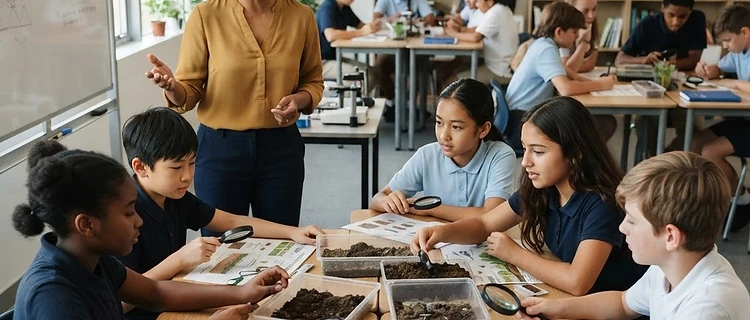
Moving from traditional teacher-led instruction to inquiry-led agricultural pedagogy requires a shift in how you view the school farm. Instead of providing answers, your classroom should function as a living laboratory where students form hypotheses about soil properties or livestock productivity. This transition involves designing experiments where the outcome is not pre-ordained but discovered through student-led inquiry and systematic observation. By posing open-ended questions like how might soil moisture variations affect nitrogen uptake, you invite critical thinking that satisfies the higher-order cognitive demands of the CAIE syllabus. Reflect on a recent practical lesson you taught; was the environment one where students followed a strict recipe, or were they allowed to navigate the scientific process? Aim to integrate at least one investigative challenge per week where students must troubleshoot a real-world agricultural problem. This pedagogical shift builds the resilience and scientific reasoning skills necessary for high achievement in Cambridge assessments.
Designing Student-Facing Learning Intentions
Effective learning intentions are the cornerstone of a student-centred classroom. They must be transparent, actionable, and aligned directly with the syllabus assessment objectives. When a student knows exactly what they are learning and why, their engagement levels rise significantly. To practice this, take one topic from the 0600 syllabus and rewrite it into three tiered learning intentions: one for foundational knowledge, one for application, and one for analytical evaluation. These should be displayed clearly at the start of your lesson and revisited throughout the session. Try this in your classroom: co-create a success criteria checklist with your students based on the mark scheme for a typical practical project. When students participate in defining what high-quality work looks like, they take ownership of their learning. This collaborative approach not only improves outcomes but also fosters a professional classroom culture that reflects the high standards of an international school setting.
Bridging Theory to Practical Competency
The ultimate goal of this pedagogical shift is to synthesize academic theory with practical school farm evidence. As you prepare your portfolio, you must be able to defend how your lesson choices lead to measurable improvements in candidate performance. This requires a disciplined focus on using syllabus-aligned resources and annotating mark schemes to inform your teaching. By documenting these links—for example, showing how a hands-on composting project maps to the sustainability objectives of the syllabus—you build a compelling narrative of your professional readiness. Engage with the MastaLearn community to share your lesson artefacts and receive peer critique on whether your activities truly push students toward the higher mark bands. Remember, the transition to being a high-impact IGCSE Agriculture teacher is a continuous process of calibration. Stay committed to refining your practice, integrating feedback, and ensuring that every practical hour contributes to a cohesive, high-achieving learning experience for your students.