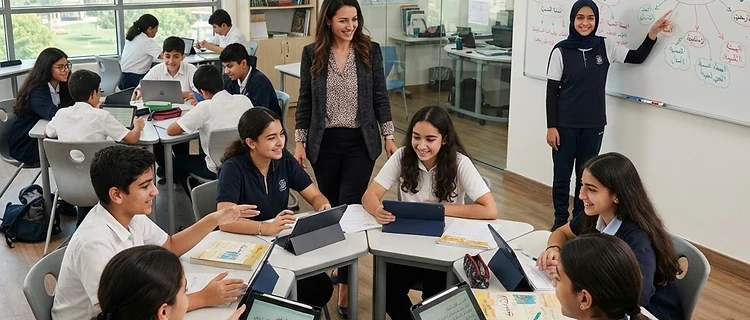
Redefining Active Learning in the Arabic Context
Active learning in the context of Cambridge IGCSE Arabic 0508 and 0544 requires a shift from teacher-led delivery to student-centred investigation. For language acquisition and textual analysis, this means moving beyond rote memorization of classical grammar rules towards collaborative application. Instead of lecturing on nahw or sarf, teachers should design activities where students deduce rules through textual patterns in authentic Cambridge-style reading passages. Pause and reflect: consider a recent lesson where you spent more than ten minutes explaining a grammatical concept. Could the students have arrived at that rule themselves by comparing two contrasting sentences? This transition is crucial for building the metacognitive skills required for the 0508 Paper 2 analytical tasks. By fostering an environment where students actively construct knowledge, you ensure that they are not just receiving content but developing the precise linguistic toolkit required for high-level textual synthesis and sophisticated composition writing.
The Distinction Between Passive Instruction and Active Outcomes
Passive instruction often results in superficial understanding, whereas active learning drives deep, transferable knowledge. In an Arabic classroom, passive instruction might involve students copying notes on stylistic devices from the whiteboard. Conversely, active learning tasks involve students analysing those same devices in a sample candidate script, then evaluating why the candidate achieved specific marks based on the official assessment criteria. Try this in your classroom: next week, replace a teacher-led vocabulary list with a collaborative synonym-mapping exercise where students negotiate meanings based on contextual clues within an unseen text. This shift aligns perfectly with the command words used by CAIE, such as analyse, evaluate, and justify. When students actively engage with the marking process, they begin to internalise the examiner mindset, transforming their own writing as they recognise how examiners reward specific structural choices and nuanced vocabulary in both the First and Second Language curricula.
Scaffolding for Diverse Linguistic Ability
In a mixed-ability IGCSE classroom, differentiation is not about teaching different content, but providing diverse access points to the same high-standard curriculum. For learners struggling with Arabic composition, scaffolding might include graphic organisers that break down the paragraph structure of an argumentative essay or sentence starters that model sophisticated discourse markers. High-achieving students, meanwhile, should be provided with extension pathways, such as analysing the impact of archaic versus modern rhetorical devices in a piece of literary prose. As you prepare your Differentiated Lesson Plan for your portfolio, consider how you can use tiered tasks to support all learners without diluting the rigour of the Cambridge objectives. Remember that effective differentiation involves monitoring student progress in real-time, allowing you to fade support as confidence grows. By documenting these scaffolds in your portfolio, you demonstrate your capacity to cater to diverse learners while maintaining the high standards of the CAIE syllabus.
Metacognitive Strategies for Textual Analysis
Metacognition involves students thinking about their own thinking, a vital skill for candidates attempting to summarise lengthy Arabic texts. To foster this, incorporate think-aloud protocols where students verbalise their process of selecting key information from a source text. When students articulate why they included a specific point in a summary, they become more aware of their own cognitive processes, leading to more accurate and concise writing. Challenge yourself to integrate a reflection journal where students briefly note which grammatical rule they found most challenging during a lesson and how they resolved their confusion. This practice bridges the gap between classroom exercises and the final examination, providing you with evidence of how your instruction promotes self-regulated learning. As these students gain agency, their performance on complex composition tasks improves, reflecting the deeper understanding of textual structure and grammatical precision that the Cambridge assessment objectives explicitly reward and prioritise.
Building the Portfolio of Evidence
Your Differentiated Lesson Plan serves as the bridge between theory and practice, providing concrete evidence of your instructional efficacy. When designing this document, ensure that your learning activities are explicitly linked to the CAIE 0508 and 0544 assessment objectives. Use your lesson planning process to document how you have adapted your teaching for students with varying levels of classical Arabic proficiency. As you prepare this portfolio, think of each activity as a piece of data that proves your readiness to lead a Cambridge classroom. Include student work samples where possible, annotating them to show how specific scaffolds helped students overcome common errors. By linking your pedagogical approach to official mark schemes and syllabus requirements, you create a compelling portfolio that justifies your instructional decisions. This rigorous documentation process prepares you for the final oral readiness review, where you will defend your professional choices to an expert mentor.