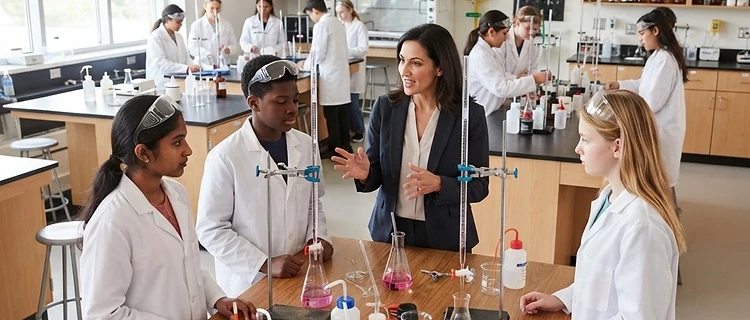
Welcome to Module 3, where we translate theory into the heartbeat of the chemistry classroom. Our focus today is on the practical delivery of Paper 6 skills, specifically targeting the orchestration of laboratory experiments and the systematic grading of stoichiometry. When students approach Paper 6, they often view it as a theoretical task, but our goal as practitioners is to ground every experiment in physical or virtual reality. Think about your last lab session. Did your students understand the experimental design, or were they simply following a recipe? To truly prepare them for Paper 6, you must facilitate sessions that require them to control variables, record precise observations, and explain why specific apparatus is used. Pause and reflect: how often do your students explain the reason for using a volumetric pipette instead of a measuring cylinder in their write-ups? This is the core of Paper 6 design questions.
Setting up physical practicals requires more than just reagents and glassware; it requires a pedagogical framework that mirrors the assessment criteria. When students measure volume or mass, they should be documenting their method with the same precision demanded by the mark scheme. If physical labs are constrained, virtual simulations provide an excellent platform for students to practice manipulating independent variables without the anxiety of spills or breakage. Try this in your classroom: assign a virtual titration experiment where students intentionally select the wrong indicator, then have them describe the impact this would have on their results. This exercise directly correlates to the Paper 6 requirement to identify sources of error and suggest improvements to experimental procedures.
Stoichiometry remains a significant hurdle for many learners, often because they view it as abstract mathematics rather than a physical representation of particle behavior. Grading these steps effectively involves more than marking the final answer; you must evaluate the process, including the conversion of units, the use of mole ratios, and the identification of limiting reactants. In your next lesson, use a traffic light system to grade student responses to a multi-step stoichiometry problem. Identify which stage of the calculation caused the breakdown: was it the interpretation of the balanced equation or a failure in unit conversion? Providing this granular feedback helps students internalize the CAIE assessment standards while building the confidence needed to handle complex stoichiometry questions during exams.
The experimental design component of Paper 6 often separates top-tier candidates from the rest. Students must learn to articulate their thoughts using precise command words like explain, suggest, and describe. In your professional practice, move away from simple worksheet drills and toward inquiry-based design tasks. Present students with a raw scenario, such as purifying a contaminated salt sample, and ask them to draft an experimental plan. As you review their plans, use a student-facing rubric that reflects the examiner-level expectations: are they controlling variables? Have they outlined a safety precaution? Are their measurements realistic? This aligns with our MastaLearn focus on converting official mark schemes into actionable feedback.
As we progress through this module, remember that your role as an educator is to model the scientific process. When you demonstrate a titration or a rate-of-reaction experiment, narrate your thinking process aloud. Why are you rinsing the burette with the titrant? Why are you reading the meniscus at eye level? These seemingly minor actions are the technical details that earn students marks in Paper 6. Reflect on your teaching: when you conduct a demonstration, do you engage the students in predicting the outcome before the action occurs? Prediction, observation, and analysis form the bedrock of the Cambridge practical assessment philosophy, and your classroom should be a safe space to cultivate these habits.
Finally, consider the documentation of your students' practical journey. A well-organized laboratory notebook serves as a record of skill acquisition and a roadmap for improvement. Encourage your students to maintain a log where they document their procedural tweaks, errors encountered, and successful outcomes. This practice not only prepares them for the rigors of Paper 6 but also provides you with a rich source of formative assessment data. As you work through this module, keep your portfolio capstone in mind. Every lesson you design, every rubric you create, and every piece of feedback you provide can be evidence of your mastery and classroom readiness. This is the synthesis of our efforts—creating learners who think like chemists and teachers who assess with examiner-level precision.