Understanding the Purpose of Your Digital Portfolio
The Digital Portfolio serves as your professional narrative, bridging the gap between theoretical pedagogical knowledge and tangible classroom expertise. For an IB Physics educator, this is not merely a collection of lesson plans, but a curated evidence pack demonstrating your mastery of the DP framework. Think of it as a living document that captures your professional growth as you navigate the complexities of Paper 3 options and internal assessment moderation. By documenting your instructional design process, you prove to future employers that you can translate complex IBO requirements into scaffolded, student-centred learning experiences. Pause and reflect: if you were to evaluate your own teaching impact today, which piece of student work would most accurately represent your current pedagogical competency? Start by identifying a single lesson artifact that successfully shifted student understanding from rote memorization of formulas to deep conceptual mastery of uncertainty propagation.
Curating Evidence of Pedagogical Competency
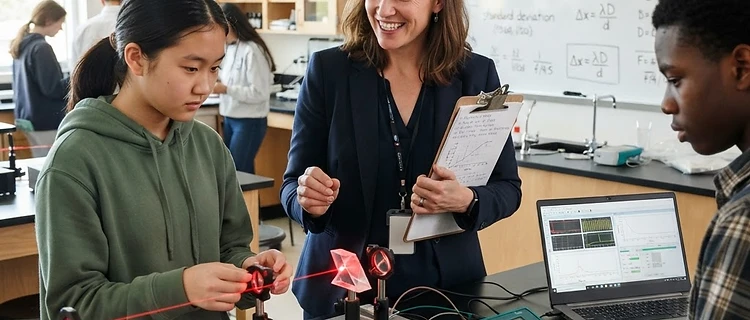
Selecting appropriate artifacts is the bedrock of a compelling portfolio. Focus on materials that highlight your ability to scaffold difficult topics such as quantum mechanics or wave optics. Useful evidence includes differentiated worksheets that address various student learning needs, annotated scripts that show how you provide actionable feedback aligned with IBO mark schemes, and photographic evidence of students engaging in active physics inquiry. When curating these items, ensure they are accompanied by a brief rationale explaining why you chose them and how they relate to specific DP assessment objectives. Try this in your classroom: next week, record a quick 5-minute debrief of a practical lab session where you highlight how you supported a student struggling with error analysis. This reflection becomes a high-value portfolio entry, proving you can diagnose and remediate specific misconceptions in real-time, thereby fulfilling the MastaLearn focus on rigorous experimental design.
Establishing a Reflective Framework for Growth
A portfolio is only as strong as the reflection behind it. To move beyond descriptive writing, adopt a structured reflective cycle such as the Gibbs model or the Kolb experiential learning cycle. When analyzing your lesson effectiveness, focus on the impact of your interventions on student outcomes rather than just your teaching actions. For instance, when reflecting on a lesson about standard deviation, do not just describe the activity; instead, explain how the data analysis allowed students to better justify their conclusions in their internal assessment report. Ask yourself: did the students demonstrate improved fluency in using the command terms after this intervention? By consistently linking your reflective entries to IBO criteria and student performance data, you transform your portfolio into a professional self-evaluation tool. This practice is essential for the readiness review, as it allows you to defend your professional decisions with evidence-based reasoning.
Aligning Classroom Practice with IBO Standards
Alignment is the hallmark of a veteran IB Physics teacher. Every artifact in your portfolio must demonstrate a clear connection to the official syllabus documents and examiner reports. This means your lesson objectives should map directly to the assessment objectives, and your formative assessment strategies should mirror the standards expected in formal Paper 3 examinations. Use the MastaLearn library to cross-reference your lesson plans against specimen papers, ensuring your mark schemes are calibrated correctly. A well-designed portfolio demonstrates that you understand not just how to teach physics content, but how to prepare students for the specific demands of the IB examination environment. Interactive prompt: take one of your existing lesson rubrics and annotate it to show exactly where it aligns with an IBO marking criterion. This exercise demonstrates your capability to standardize physics IA rubrics, which is a key course objective.
Preparing for the Portfolio Oral Readiness Review
The final stage of this module is preparing for your oral defense, where you will articulate the pedagogical rationale underpinning your portfolio. This is your opportunity to demonstrate professional maturity and an ability to respond to critique. Prepare by synthesizing your reflections into a cohesive narrative that highlights your development as an IB educator. Be prepared to discuss how you have addressed challenges such as scaffolding error propagation for diverse learners or managing the complexities of internal assessment moderation. Think critically about your failures as well as your successes; the best evidence in a portfolio often stems from a lesson that did not go as planned, followed by a robust, iterative improvement process. Engage with peers in the community forum to practice summarizing your professional philosophy. By articulating your choices clearly, you prove classroom readiness and a deep commitment to excellence in the IB Physics community.