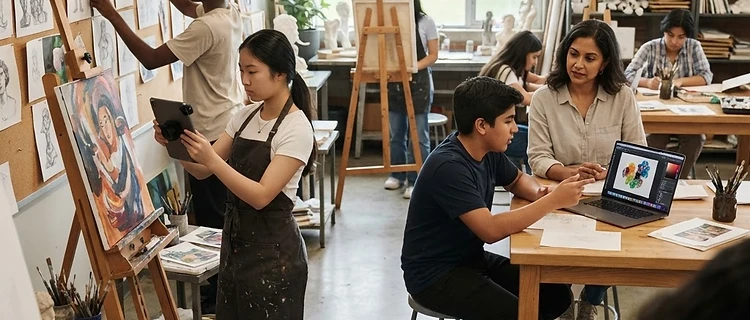
Welcome to Module 3, where we bridge the gap between abstract syllabus expectations and the tangible reality of your classroom. In the IB DP Visual Arts programme, the Process Portfolio is often where students falter, not for lack of creativity, but for lack of structural guidance in articulating their iterative process. Your role as an instructor is to facilitate the transition from a messy creative journal to a professional, curriculum-compliant digital document. When students document their work, they must demonstrate the process of experimentation rather than just the final outcome. Consider the last time you saw a student produce a beautiful final painting but neglect to show the initial, failed trials. That student loses significant marks because the IBO requires evidence of informed choices and reflections that move the work forward. Pause and reflect: do your current classroom templates encourage students to date their experimentation entries, or are they relying on memory to piece together a narrative at the end of the term? Start by implementing a weekly check-in where students annotate one 'pivot point' in their process to ensure they are capturing the required evidence in real-time.
Moving to the Comparative Study, teachers often struggle to move students beyond descriptive writing into true academic analysis. A common pitfall is the student who summarizes the history of an artwork instead of comparing its formal qualities or cultural significance with their own studio work. You must guide students to treat art history as a dialogue with their own creative practice. Try this in your classroom: provide your students with a 'Comparison Grid' that forces them to look at two distinct works and identify one specific technical connection and one thematic divergence. By restricting the scope, you help them develop the depth of analysis required for higher mark bands. Remember, the examiner is not looking for a lecture on art history; they are looking for a student's ability to critically analyze and synthesize connections. When you provide feedback, ask yourself if the student is merely explaining the 'what' or if they are successfully demonstrating the 'how' and 'why' regarding their artistic influences.
The physical or digital exhibition serves as the final, public-facing component of the Visual Arts course. Many teachers approach curation as an afterthought, but effective exhibition design is a skill that must be taught over the course of the two years. A compliant exhibition must feature a coherent selection of artworks that clearly relate to a theme or a specific line of inquiry. As a teacher, you need to create 'curatorial rubrics' that students use to peer-evaluate their own potential exhibition layouts. By having students justify their placement of works, you are training them to speak with the authority required for the moderation process. Think about your classroom space: is it currently set up to allow students to mock up exhibition displays? If not, consider how you might repurpose empty walls or digital slide decks to simulate the exhibition experience. This practice demystifies the moderation process and builds student confidence, making the final exhibition day less about anxiety and more about professional accomplishment.
In the context of the Process Portfolio, it is essential to emphasize that the document is a reflection of the creative journey, not a polished portfolio of final outcomes. Teachers should coach students to document mistakes, dead ends, and technical trials with the same enthusiasm as their successes. If a student is stuck, encourage them to write a 'Problem Statement' for their next entry: what are they trying to solve, and what material or technique did they test to address it? This structure ensures that the portfolio is inherently academic and meets the IBO's focus on the sustained process. When reviewing drafts, look for the 'Evidence of Intent'—can you clearly track a progression of ideas from the initial brainstorm to the final realization? If the narrative is missing, the student needs to add reflective commentary that bridges the visual evidence. This is where your intervention as an expert pedagogue transforms a casual sketchbook into a high-scoring assessment file.
The Comparative Study requires a specific balance of visual and written content, and students often neglect the technical analysis of media. To improve scores, challenge students to describe the 'artist's tools' in detail. How was the paint applied? What was the surface preparation? How does the texture of the material impact the viewer's interpretation of the theme? By narrowing the focus to these technical aspects, you help students avoid the trap of vague, subjective interpretation. Try this in your classroom: take a single, famous artwork and have the class write three sentences exclusively about the material application and its effect. This exercise in 'looking closely' is a transferrable skill that will improve their ability to analyze their own studio works. Effective moderation relies on the clarity of this analysis, so ensure that the language used is precise, art-historical, and directly related to the visual evidence presented on the page.
Finally, managing the moderation process involves meticulous record-keeping and a proactive approach to exhibition compliance. You must ensure that every student's exhibition is well-lit, clearly labelled, and that the rationale for each piece is documented in a way that examiners can easily understand. Create a checklist for your students that covers every requirement from the syllabus—this reduces the mental load and allows them to focus on the quality of their work. During the exhibition week, treat the classroom as a professional gallery space. Encourage students to curate their own labels and artist statements, as these are critical components of the moderation file. By treating the assessment process with the same level of care you apply to your own pedagogical design, you create an environment where high grades are not just possible, but expected. Your role is the final gatekeeper of standard-setting, ensuring every student has the best possible opportunity to demonstrate their mastery.