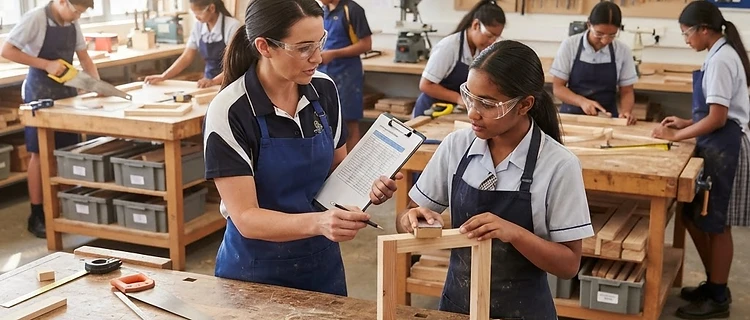
Welcome to Module 3 where we transition from theory to the physical realities of the Junior Secondary school workshop. In this module, we focus on the delicate balance between fostering creativity through practical tasks and maintaining the rigour of objective assessment. As a teacher, your workshop is a laboratory for innovation, but it requires meticulous planning to ensure that students not only learn the craft but also respect the materials and tools provided. We will explore how to set up practical sessions that are safe, structured, and aligned with the CBC framework. Think of your workshop as a learning environment where every project is an opportunity for a student to demonstrate a specific competency. Pause and reflect: how often do you find that your current project briefings lead to confusion or material wastage? Consider how a clearer initial demonstration might mitigate these common classroom challenges.
Material conservation is a critical pillar of this module. In many schools, resources are finite, and the ability to manage timber, metal, or electronic components effectively is a skill you must model for your students. We will look at practical strategies for 'measure twice, cut once' methodologies that prevent unnecessary waste. Beyond saving costs, this practice instills a professional ethos in learners. Try this in your classroom this week: introduce a 'material requisition' slip where students must justify their needs before receiving stock. This small shift in process forces students to think critically about their design dimensions before they ever touch a saw or a soldering iron. This is not just about cost-cutting; it is about building the habit of precision that is required in all technical professions.
When it comes to grading finished projects, the shift from subjective opinion to objective rubrics is essential for teacher credibility and student development. A rubric should act as a map for the student, showing them exactly how their physical artifact translates into a competency grade. We will examine how to decompose a KICD syllabus objective into observable criteria such as dimensional accuracy, joining technique, and finish quality. By providing these rubrics before students begin their work, you demystify the assessment process. Reflect on your last marking cycle: were students surprised by their grades, or did they anticipate them based on the criteria provided? If they were surprised, it is likely that your rubrics were not sufficiently transparent or shared early enough in the production cycle.
Setting up an effective practical task requires a 'demonstration-practice-review' sequence. In the demonstration phase, you must focus on safety command words and tool handling. During the practice phase, your role shifts to that of a facilitator, moving around the room to offer formative feedback. This is the moment to catch errors before they become permanent flaws in the artifact. Think about your last workshop session: did you spend the entire time managing tools, or were you able to engage in one-on-one 'calibration' sessions with students? If you were tied to the desk or the tool cabinet, consider how delegating safety monitor roles to senior students might free you up to provide the high-quality feedback that drives student progress.
Calibration is the backbone of consistent assessment in the technical department. We encourage departmental moderation sprints where you and your colleagues mark the same piece of student work independently and then compare results. This process of moderation is vital for ensuring that a 'proficient' grade in your workshop means the same thing as it does in your colleague's classroom. When you sit down to grade, use the official syllabus documents to anchor your judgments. Do not let personal bias regarding a student's effort obscure the actual technical quality of the output. Focus exclusively on what is observable and measurable. This professional rigour is what protects your reputation as a fair assessor and supports the credibility of your school's technical programme.
As we conclude this module, your final challenge is to prepare for your capstone portfolio by documenting a complete project cycle. This includes your lesson plan, the rubric you created, and annotated photos of a student project at various stages of completion. This portfolio will serve as proof of your ability to manage a workshop, conserve resources, and grade objectively. It is a powerful tool for your professional growth and a tangible asset when you apply for future leadership roles within the CBC framework. Always remember that your goal is to nurture the next generation of technicians, engineers, and designers who understand that high-quality craftsmanship is born from discipline, safety awareness, and an unwavering commitment to assessment standards.