Crafting Your Professional Narrative
The Portfolio Capstone Studio represents the culmination of your journey through the Senior School STEM pathway. In this section, we focus on synthesizing your diverse classroom experiences into a cohesive professional narrative. Rather than viewing your portfolio as a collection of disjointed documents, consider it a structured argument that proves your pedagogical readiness. You must weave together your proficiency in Advanced Mathematics, the precise management of physics and chemistry labs, and your command over technical engineering tracks. Think of your narrative as a storyline where you are the protagonist who navigates complex syllabus requirements while supporting diverse learners. Pause and reflect on your growth over these past modules. How have your instructional methods evolved from generic teaching to specialized STEM delivery? Identify three specific artifacts from your practice that demonstrate this evolution. Try this in your classroom: write down three moments where you shifted from teacher-led instruction to facilitating student-led inquiry in the laboratory.
Preparing the Oral Readiness Review
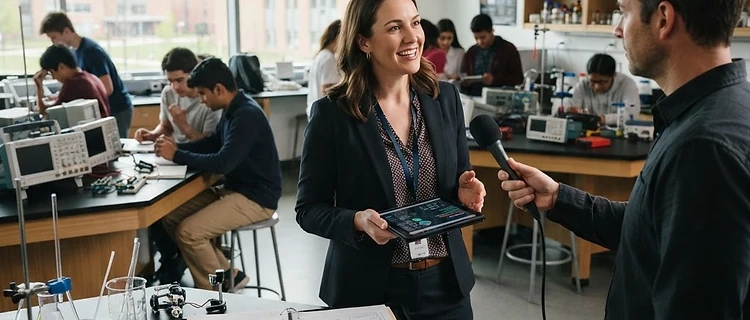
The oral defense is your opportunity to speak directly to your professional competence. It is not merely a summary of your portfolio but a rigorous interrogation of your pedagogical philosophy and its application within the CBC framework. When preparing, focus on justifying your instructional choices through the lens of student outcomes. Why did you choose specific assessment criteria for your marked student samples? How does your feedback directly influence future performance in technical tracks? A successful defense requires you to articulate the 'why' behind your 'what'. For example, if you chose a particular rubric for a physics practical, you must explain how that specific tool improved student accuracy in data collection. Practice explaining your decision-making process out loud, focusing on alignment with KNEC and KICD standards. Remember that clarity and confidence in your alignment with official assessment objectives are the hallmarks of a master practitioner ready for senior school responsibilities.
Integrating Marked Student Samples
Your submitted marked student sample serves as the cornerstone of your portfolio evidence pack. This artifact provides tangible proof of your ability to apply mark schemes with examiner-level accuracy while delivering actionable, student-focused feedback. To prepare this, select a sample that highlights your ability to diagnose common student misconceptions in STEM subjects. Ensure your feedback moves beyond simple error correction; it must challenge the student to rethink their approach or justify their calculations in mathematics. As you annotate this sample, think about how your comments correlate with the official assessment objectives. A high-quality submission demonstrates that you can identify exactly why a student missed a mark and how they can bridge that knowledge gap. Take time to cross-reference your marking against the official examiner reports provided in the MastaLearn library. Does your feedback lead the learner toward higher-order thinking or just task completion?
Defense Strategy and Evidence Synthesis
Structuring your oral defense requires a clear, logical flow that guides your reviewer through your pedagogical landscape. Begin with your overarching teaching philosophy, then zoom into specific classroom applications like lab management or complex mathematics problem-solving. Use your portfolio as a supporting document to provide concrete evidence for every claim you make. If you state that you are skilled at differentiation, point immediately to the annotated rubric or the modified lesson plan that catered to different learner needs. Your strategy should anticipate potential questions from the examiner, such as how you handle laboratory safety during intensive engineering projects or how you manage marking loads for large STEM cohorts. Preparation is the key to maintaining composure. Create a set of index cards with key data points from your portfolio. Try this in your classroom: role-play a mock defense with a colleague, asking them to probe your reasoning behind your latest student sample markings.
Professional Reflection and Future Growth
As you finalize your portfolio, reflect on your ongoing journey as a professional educator within the CBC landscape. Your readiness is not a final destination but a commitment to iterative improvement. The Portfolio Capstone Studio challenges you to acknowledge both your successes and the areas where you have identified a need for further development. This self-evaluation is critical for a senior educator; it shows maturity and a deep understanding of the reflective cycle. In your final readiness review, discuss how you plan to continue monitoring student progress using the data-driven methods learned in this course. Consider how you will mentor junior colleagues or lead departmental moderation sprints in your future school setting. By grounding your future goals in the practical strategies developed here, you demonstrate not only current competency but also the capacity for leadership within the broader Senior School STEM pathway. You are prepared to lead.