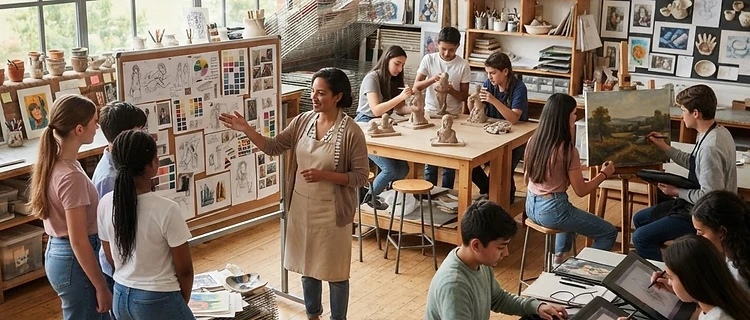
Defining Metacognition in the Art Studio
Metacognition in the IGCSE Art and Design studio is not merely about students finishing a task but about them understanding the journey of their own creative process. When we talk about First-hand Recording, we are asking students to act as researchers and observers of the world around them. For teachers, fostering this means moving beyond simple technical instruction to ask students why they chose a specific vantage point or why a particular medium failed to capture the texture they intended. By integrating metacognitive prompts directly onto preparatory boards, you encourage students to document their decision-making process, which is essential for AO1 and AO2 evidence. Try this in your classroom today: provide students with a set of reflective stems such as I chose this perspective because or I altered my approach when I noticed that. As you plan your differentiated lesson, consider how these prompts can be scaffolded to support different learning needs.
Connecting Reflection to AO1 and AO2
The Cambridge assessment objectives reward evidence of intent and refinement. AO1 focuses on recording ideas from first-hand study, while AO2 involves the process of refinement and experimentation. When a student reflects on their own work, they provide the moderator with a clear narrative of their artistic growth, which directly boosts their marks. A student who simply presents a final drawing lacks the depth found in a peer who documents their trial and error, explains why they abandoned a technique, and details how they adapted to a material limitation. Pause and reflect: look at your current sample portfolios. Do they show the dialogue between student thought and visual outcome? If not, your next task is to design a lesson activity where students annotate their own work using specific command words from the syllabus, turning silent preparatory boards into vocal evidence of high-level analytical thinking and persistent creative development.
Scaffolding for Diverse Mediums
Supporting different mediums like fine art, 3D, and digital requires flexible metacognitive scaffolds. A digital student might record their layer transparency settings as a form of reflection, while a 3D artist might photograph the structural collapse of a clay armature as a critical learning moment. Your role as a teacher is to ensure every student, regardless of their chosen medium, understands that their documentation of these challenges is worth marks. When preparing your differentiated lesson plan, categorize your students into tiers of support. High-achieving students might generate their own reflective questions, while those needing more guidance can use provided templates that map their process against the syllabus criteria. This ensures that every student can access top-mark bands. Think about how a 3D sculpture student can document the evolution of a form by writing captions that explain their choice of material, directly demonstrating their understanding of formal qualities.
Internal Standardization and Collaborative Moderation
Internal standardization is the process where teachers within a department align their expectations to ensure consistency. When we teach students to be metacognitive, we are also making our own internal moderation easier because the student has explicitly stated their intentions and evaluations in their work. This minimizes the guesswork for markers. During your departmental moderation sprints, try selecting two student boards that show excellent reflective practice and two that lack it. Discuss as a team why the reflective ones allow for more accurate assessment against the criteria. This collaborative effort helps you refine your teaching practice and ensures that the feedback you provide is consistent across your department. Use this exercise to inform your portfolio evidence pack, as demonstrating the ability to lead or participate in effective standardization is a key requirement for your readiness review. Remember, consistency is the bedrock of credible assessment.
Developing the Differentiated Lesson Plan
As you finalize your two-week scheme of work and your differentiated lesson plan, synthesize these metacognitive strategies into actionable tasks. Your plan must demonstrate how you cater to diverse learners by offering tiered scaffolds, extension pathways for gifted artists, and specific interventions for those struggling with visual documentation. Include a section on how you will use formative feedback to nudge students toward more critical reflection. This is a critical component of your portfolio capstone, as it proves to employers that you can translate complex syllabus requirements into an inclusive classroom reality. Before you submit, check that every activity is mapped to the AO1 and AO2 assessment objectives. Ask yourself if a moderator can clearly see the progression from initial idea to refined outcome in the lesson evidence. Your lesson plan should serve as a blueprint for student success, clearly documenting how you mentor students to become independent and highly reflective creators.