The Criticality of Compliance in Moderation
In the context of Cambridge IGCSE Physical Education practical moderation, your role as a teacher is not merely to assess but to provide objective, irrefutable evidence of a candidate performance. When submitting video evidence, compliance is the absolute baseline requirement. Examiners often struggle to justify marks when camera angles obscure critical movement phases or background noise masks teacher commentary. Consider this your first step toward building your differentiated lesson plan for your portfolio. When you design your practical sessions, you are setting the stage for moderation success. If the video evidence fails to show the specific technical requirements defined in the syllabus, the moderator cannot award high marks regardless of how skilled the student actually is. Take a moment to pause and reflect on your last video submission. Did the audio clearly capture the rationale for the awarded marks? If not, you are missing an opportunity to advocate for your students through professional documentation.
Mastering Technical Framing and Audio Standards
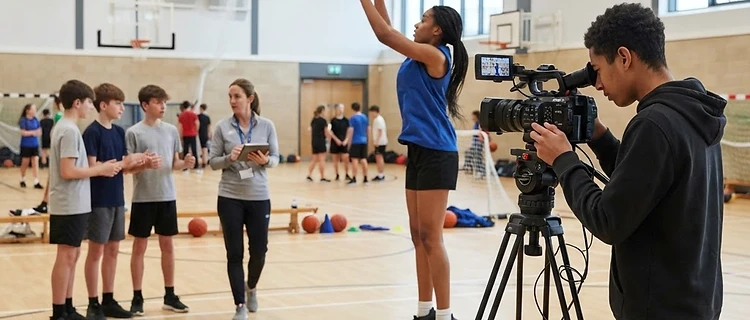
Effective video submission is a blend of sports science and videography. You must ensure that the camera captures the full range of movement required by the specific assessment criteria. For instance, in an activity like basketball, the framing must be wide enough to show the player in relation to the court boundaries yet close enough to observe technical accuracy in dribbling or shooting. Try this in your classroom this week: conduct a trial recording session where you experiment with tripod placement to minimize camera shake and ambient noise. Use an external microphone if your gym has poor acoustics, as echo is a common enemy of clear assessment commentary. In your differentiated lesson plan, you should include a station specifically for students to practice self-filming. This allows them to develop metacognitive awareness of their own performance while teaching them the technical constraints of the moderation process you are managing.
Developing Student-Centred Compliance Checklists
To reduce the burden on your administrative time, move the responsibility of compliance into the hands of your learners. Developing a student-facing checklist is a powerful tool for promoting autonomy. This checklist should explicitly list the moderation requirements: athlete identification, specific skills demonstrated, and the absence of extraneous background activities. When students understand the criteria, they stop performing for the teacher and start performing for the camera. This is a perfect point to integrate into your portfolio evidence pack. By co-constructing this checklist with your students, you demonstrate an inclusive teaching approach that values their input while maintaining the rigour required by Cambridge. Think about how this checklist could be scaffolded for diverse learners. Could you provide a visual version for EAL students or a simplified version for those needing extra support? This exercise directly serves the differentiation requirement of your final teaching portfolio submission.
Metacognition Through Video Self-Review
The true value of video submission lies in the reflective loop it creates for the learner. When students watch their own performances through the lens of the assessment criteria, they shift from passive participants to active analysts. This metacognitive engagement is what separates high-achieving students from those who struggle to conceptualize their own errors. During your next practical session, record a sequence and allow students to watch it immediately, using the rubric to self-assess their own performance against a specific command word. This practice is essential for your lesson plan, as it demonstrates your ability to use technology to bridge the gap between abstract criteria and tangible physical action. Ask yourself how you can facilitate peer-feedback during this process. Can students use the moderation checklist to provide constructive criticism to one another, thereby deepening their understanding of the standards before you finalize any marks for the official submission?
Bridging Theory and Practice for Portfolio Success
As we approach the end of Module 3, it is vital to synthesize these technical requirements with your broader pedagogical goals. Your digital portfolio requires evidence that you can translate complex syllabus requirements into actionable classroom instruction. By implementing these video compliance protocols, you are not just ticking a box for the board; you are creating an authentic learning environment where standards are transparent and accessible. Your final portfolio submission must clearly show how these practical simulations were differentiated to meet the diverse needs of your cohort. Consider how you will document this. Perhaps you include a sample of a student-completed checklist or a reflection on how the filming process changed student engagement levels. Every piece of evidence should articulate your professional judgment as an examiner. This is your chance to prove that you are not just delivering content, but actively shaping the assessment literacy of your students.